

The handshake that cost everything: why partnership incorporation is not optional
Millions of Indian businesses still run on trust, goodwill, and a verbal agreement. Here is why that is a gamble — and what incorporation actually gives you in return.
Picture two friends who decide to start a textile trading business. They split costs, divide profits 50/50, and shake hands over chai. Two years later, one partner dies unexpectedly. The other discovers there is no legal record of the business, no defined profit-sharing arrangement enforceable in court, and no mechanism to continue operations. The firm, for all practical purposes, dissolves overnight.
This is not a hypothetical. It plays out across thousands of micro and small enterprises in India every year — and it is almost entirely preventable. The solution is not complicated. It is called partnership incorporation.
What does “incorporating” a partnership actually mean?
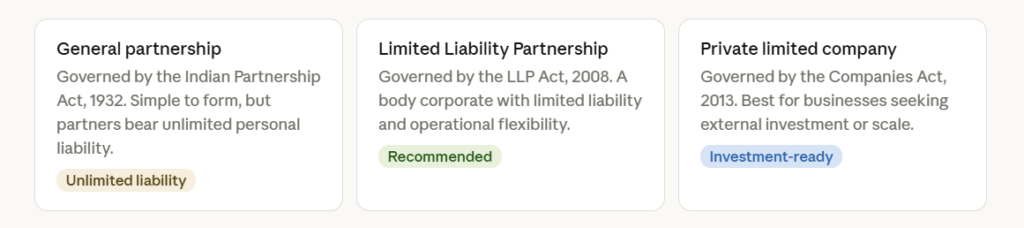
In plain terms, incorporating a partnership means converting what would otherwise be an informal arrangement between two or more people into a legally recognised entity — one with rights, obligations, a name, and a paper trail. In India, entrepreneurs have three primary vehicles to choose from depending on their scale, liability preference, and long-term vision.
The registration trap: why most partnerships stay informal
Registration of a general partnership under the Partnership Act, 1932, is technically optional. This is where many business owners make a costly mistake — they read “optional” as “unnecessary.” But an unregistered firm carries a severe legal handicap: it cannot enforce its contractual rights in a court of law. An unregistered firm cannot file a suit to recover dues from a defaulting customer, nor can a partner sue the firm or co-partners for their rights. The business exists socially, but legally, it is invisible.
The LLP: India’s most underused business structure
Introduced in 2008, the Limited Liability Partnership remains one of the most underused yet most versatile structures in the Indian business ecosystem. It combines the operational flexibility of a partnership — where partners manage the business directly — with the liability protection of a company. Each partner’s personal assets are ring-fenced from the firm’s obligations, which is a transformational protection compared to a general partnership.
The incorporation process is entirely digital. An LLP is incorporated by filing Form FiLLiP (Form for incorporation of Limited Liability Partnership) with the Ministry of Corporate Affairs, along with the LLP Agreement — a document that governs profit-sharing, roles, decision-making, and exit provisions. The typical timeline from application to Certificate of Incorporation is 10 to 15 working days.
What the LLP Agreement must address
Many incorporations are technically compliant but commercially incomplete because the LLP Agreement is drafted as a formality rather than a functional governance document. A robust agreement must address:
- Profit and loss sharing ratios, including provisions for revision over time
- Capital contribution obligations and the consequences of default
- Decision-making authority — what requires unanimous consent versus majority
- Exit and buy-out mechanisms if a partner wishes to retire or is incapacitated
- Dispute resolution procedures, preferably including arbitration
Compliance is not a one-time event
Incorporation is the beginning, not the end. An LLP must file an Annual Return (Form 11) and a Statement of Accounts (Form 8) each financial year with the Registrar of Companies. Failure to comply attracts per-day penalties that accumulate rapidly. Businesses that treat incorporation as a checkbox exercise — and then ignore compliance — often find themselves facing adjudication proceedings years later, precisely when they need clean records most, typically at the point of a loan application, a merger, or an investment round.
A partnership without incorporation is a relationship without a contract — functional in good times, catastrophic in bad ones. Whether you choose a registered general partnership, an LLP, or a private limited company, formalising your business structure is an investment in continuity, credibility, and legal standing. The cost of incorporation is measured in thousands of rupees. The cost of not incorporating can be measured in everything you have built.
