

Private Limited Company vs LLP for a Clinic: Which Structure Should You Choose?
Starting a clinic is one of the most rewarding — and complex — entrepreneurial decisions a healthcare professional can make. Beyond the clinical, regulatory, and operational challenges lies a foundational question that many founders underestimate: what legal structure should the business operate under? The choice between a Private Limited Company (Pvt Ltd) and a Limited Liability Partnership (LLP) will shape your taxation, governance, fundraising ability, compliance burden, and personal liability for years to come.
This article breaks down both structures in the context of a healthcare clinic, helping you make an informed decision from day one.
Understanding the Two Structures
What Is a Private Limited Company?
A Private Limited Company is a separate legal entity owned by shareholders and managed by directors. It can have up to 200 shareholders, cannot invite public investment, and offers its owners limited liability — meaning personal assets are protected from business debts. It is governed by the Companies Act and is the most widely recognized corporate structure globally.
What Is an LLP?
A Limited Liability Partnership combines the flexibility of a traditional partnership with the protection of limited liability. It is owned and managed by designated partners, has no minimum capital requirement, and enjoys pass-through taxation in most jurisdictions — meaning profits are taxed in the hands of partners rather than at the entity level. It is governed by the LLP Act and is popular among professionals such as doctors, lawyers, and consultants.
Key Comparison: Which Is Better for a Clinic?
1. Liability Protection
Both structures offer limited liability, meaning partners or shareholders are not personally liable for the debts or legal claims of the clinic beyond their capital contribution. This is critical in healthcare, where the risk of malpractice claims, supplier disputes, or regulatory penalties is real.
Verdict: Both are equally strong here. However, a Pvt Ltd company’s share capital structure offers slightly cleaner liability demarcation when multiple doctors or investors are involved.
2. Ownership and Structure
A Private Limited Company allows distinct separation between ownership (shareholders) and management (directors). This is particularly useful if:
- You plan to bring in silent investors or venture capital
- You want to issue ESOP (Employee Stock Options) to attract senior medical staff
- You anticipate a future sale or partial exit
An LLP blurs ownership and management — partners both own and run the entity. This suits smaller, closely-held clinics where the founding doctors intend to remain hands-on operators without outside equity involvement.
Verdict: Pvt Ltd wins if you plan to scale, raise capital, or bring in investors. LLP wins for a tight-knit founding team with no external equity plans.
3. Taxation
This is where the two structures diverge most meaningfully.
In an LLP, profits are not taxed at the entity level in the traditional corporate sense — partners pay tax on their share of profits at their individual income tax rate. There is no dividend distribution tax and profit extraction is more straightforward.
In a Private Limited Company, the company pays corporate tax on its profits. When profits are then distributed as dividends to shareholders, they are taxed again in the hands of the recipient — creating a layer of double taxation depending on the jurisdiction. However, reinvested profits within the company enjoy the corporate tax rate, which is often lower than the top individual rate.
Verdict: For a clinic generating steady profits that are fully distributed to founders, an LLP is generally more tax-efficient. For a clinic reinvesting profits to open new branches or buy equipment, the corporate tax environment of a Pvt Ltd can be advantageous.
4. Compliance and Regulatory Burden
A Private Limited Company carries a higher compliance load: mandatory annual filings, board meetings, statutory audits regardless of turnover, maintenance of statutory registers, and stricter disclosure requirements. These involve recurring professional fees and administrative overhead.
An LLP has significantly lighter compliance requirements. Statutory audit is only mandated beyond a certain turnover or capital contribution threshold, annual filings are simpler, and internal governance is flexible — governed primarily by the LLP Agreement rather than a rigid statutory framework.
In healthcare specifically, both structures must additionally comply with clinical establishment registration, biomedical waste rules, drug licensing, and any applicable state or national health regulations — but these sit outside the corporate structure entirely.
Verdict: LLP is considerably easier and cheaper to maintain for a small to medium clinic. A Pvt Ltd structure makes sense when the compliance cost is justified by scale or investor requirements.
5. Fundraising and Investment Readiness
This is perhaps the most decisive factor for growth-oriented clinics.
Private Limited Companies are the preferred vehicle for institutional investors, private equity, and venture capital. Equity can be issued in tranches, convertible notes can be structured, ESOPs can be granted, and the cap table is clearly visible. Most healthcare-focused funds and accelerators will only invest in a Pvt Ltd structure.
LLPs cannot issue equity to outside investors in the traditional sense. There is no concept of shares — only profit-sharing ratios among partners. This severely limits the ability to bring in external growth capital or pursue a structured exit.
Verdict: If there is any possibility of seeking external funding — for expansion, equipment, new branches, or a diagnostic center — a Pvt Ltd company is the only viable choice.
6. Brand, Credibility, and Patient Trust
A “Pvt Ltd” suffix on a clinic’s name carries a perception of institutional credibility and scale, which can matter when approaching corporate tie-ups, insurance empanelment, and hospital group negotiations.
An LLP suffix, while legally sound, is less recognized by the general public and may carry a perception of being a smaller or professional-practice entity.
Verdict: For a single-doctor or small specialist clinic, this difference is negligible. For a multi-specialty or corporate clinic brand, Pvt Ltd commands greater market credibility.
7. Dissolution and Exit
Closing a Pvt Ltd company involves a formal winding-up process that is lengthier and more procedurally intensive. However, partial exits — selling shares to a co-founder, investor, or acquirer — are clean and well-understood legally.
Closing an LLP can be simpler through a voluntary strike-off process if dormant, but restructuring ownership mid-life (e.g., one partner wanting to exit while another continues) can be legally cumbersome and requires amendment of the LLP Agreement.
Verdict: Pvt Ltd offers cleaner partial exit mechanisms. LLP is simpler to wind down entirely if the venture does not work out.
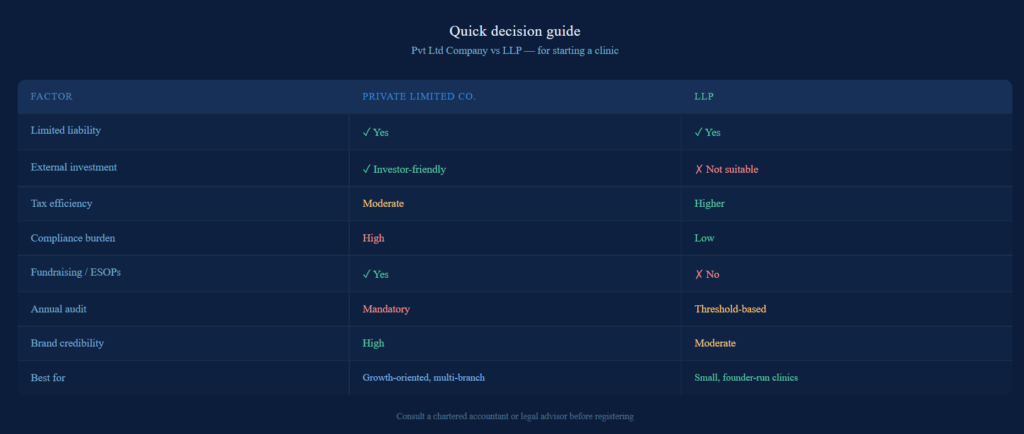
So, Which Should You Choose?
Choose a Private Limited Company if:
- You plan to open multiple branches or scale beyond a single clinic
- You intend to raise external funding from investors or healthcare funds
- You want to offer equity or ESOPs to key medical staff
- You are targeting corporate tie-ups, insurance empanelment, or eventual acquisition
- You have co-founders with unequal capital contributions that are better reflected in shareholding
Choose an LLP if:
- You are a small group of doctors starting a specialist or general practice clinic
- All founders will be active partners with no plans for outside equity
- You want to minimize compliance costs and administrative overhead
- Profits will be fully distributed annually rather than reinvested
- You prefer a simple, flexible governance structure with minimal paperwork
A Practical Note on Healthcare Regulations
Regardless of the structure chosen, clinics must comply with the clinical establishment registration requirements of their jurisdiction, relevant medical council regulations, biomedical waste management rules, and any applicable drug or pharmacy licensing. A corporate structure does not substitute for — or protect against breaches of — these regulatory obligations. It is strongly advisable to engage both a company secretary or legal advisor for structuring and a healthcare compliance consultant before registration.
Can we conclude now?
There is no universally correct answer — the right structure depends entirely on your growth ambitions, funding plans, tax situation, and operational complexity. For a solo practitioner or small founding team running a focused clinic without plans for external investment, an LLP offers simplicity, tax efficiency, and low compliance overhead. For anyone building a clinic brand with multi-location ambitions, investor backing, or a long-term exit plan, a Private Limited Company is the appropriate — and arguably only — vehicle.
Get the structure right at the start. Restructuring after the fact is possible, but it is costly, time-consuming, and disruptive to an already demanding healthcare business.
