
Land is one of the most commonly held assets and one of the most frequently misunderstood from a tax point of view. A sale that looks straightforward on paper — a buyer, a seller, a registered deed — often carries a tax outcome that depends on how long the land was held, how it was used, what the registrar valued it at, and what the seller does with the money afterwards. Getting these points right before the deed is signed is usually the difference between a planned tax cost and an unwelcome one.
This note sets out how gains on the sale of land are taxed, the relief available, and the practical steps sellers should take.
When land is taxed as a capital asset
Most land is a capital asset, and profit on its sale is taxed as capital gains. There are two important exceptions.
The first is agricultural land in a rural area. Land that genuinely qualifies as rural agricultural land falls outside the definition of a capital asset altogether, so the gain is not taxed as capital gains at all. Whether land qualifies depends on the population of the nearest municipality and the aerial distance of the land from it, tested against prescribed limits. Land that was once rural may have ceased to be so as the nearest town expanded, which is why this test should be revisited at the date of sale rather than assumed from the date of purchase.
The second is land held as stock-in-trade. Where a person buys land with the intention of developing and reselling it, or does so repeatedly as part of a trade, the profit is business income taxed at ordinary rates rather than capital gains. Frequency of transactions, source of funding, holding period and the treatment of the land in the books all feed into this assessment.
Short-term or long-term
Land is treated as a long-term capital asset once it has been held for more than 24 months. Sold within 24 months, the gain is short-term.
The distinction matters a great deal, because short-term gains are added to total income and taxed at the seller’s normal rates, while long-term gains attract a separate, generally lower rate and qualify for reinvestment relief.
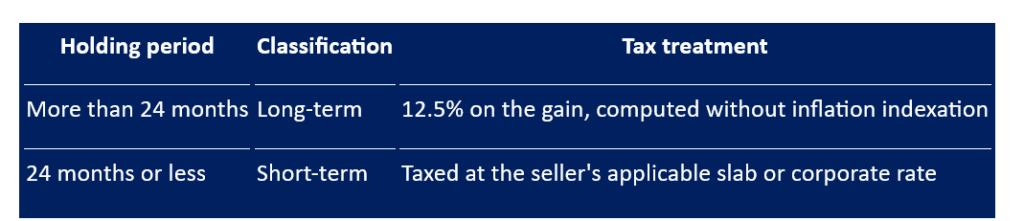
Surcharge and cess apply on top in the usual way.
A transitional option applies to land acquired on or before 22 July 2024 and sold by a resident individual or Hindu Undivided Family. For such sales, the tax payable is the lower of 12.5% computed without indexation and 20% computed with the benefit of indexation. In practice, older holdings that have appreciated modestly tend to fare better under the indexed route, while sharply appreciated land is usually better off at the lower rate. The comparison should be run on the actual numbers rather than assumed.
Computing the gain
The gain is the sale consideration, less the cost of acquisition, the cost of improvement and the expenses directly incurred on the transfer, such as brokerage, legal fees and statutory levies borne by the seller.
Three computation points cause most of the disputes:
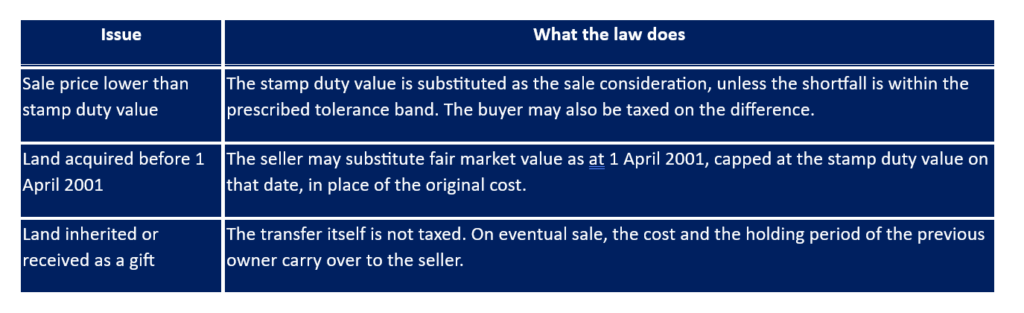
Where the stamp duty value exceeds the agreed price for genuine commercial reasons, a valuation reference can be sought during assessment. A registered valuer’s report prepared contemporaneously is far more persuasive than one commissioned years later.
Relief available on reinvestment
The law offers three principal routes to reduce or eliminate long-term capital gains tax on land, each with strict conditions and deadlines.

Where the reinvestment cannot be completed before the due date for filing the return, the unutilised amount should be deposited in a capital gains account with a scheduled bank before that date. Missing this deposit is one of the most common and most expensive errors in property transactions, because relief is lost even where the seller genuinely reinvests a few months later.
Relief once claimed is not permanent. Selling the new house or the new agricultural land within three years, or breaking the bond lock-in, brings the earlier exempted gain back into tax in the year of the breach.
Withholding, advance tax and reporting
Buyers are required to withhold tax at 1% of the consideration where the value of the immovable property crosses the prescribed threshold, and the obligation is tested on the total value of the property rather than each co-owner’s share. Where the seller is a non-resident, the position is materially different: withholding is at the rates applicable to capital gains on the whole consideration rather than at 1%, and the practical solution is for the seller to obtain a lower or nil withholding certificate from the tax authority before completion.
Capital gains are not covered by employer withholding, so sellers must pay advance tax on the gain in the instalment falling due after the sale to avoid interest. Registration authorities report property transactions to the tax administration, and these appear in the seller’s annual information statement, so an unreported gain is visible well before any notice is issued.
A note on section references
A new income tax law took effect from 1 April 2026. It renumbers and simplifies the provisions dealing with capital gains, exemptions and withholding, but does not change the substance of the treatment described above. Returns for earlier years continue to be filed under the previous numbering, so documentation prepared during the transition should be clear about which law it refers to.
Frequently asked questions
Is agricultural land always exempt? No. Only land that meets the rural test at the time of sale falls outside the capital gains net. Agricultural land within municipal limits or within the prescribed distance of a town is taxable like any other land, though reinvestment relief in fresh agricultural land may be available.
I sold a plot and want to buy a flat. Do I need to reinvest only the profit? No. For relief through a residential house, the entire net sale consideration must be reinvested to exempt the whole gain. Reinvesting only part gives proportionate relief.
Can I claim both the residential house relief and the bond relief? Yes, provided the conditions of each are independently satisfied and the combined relief does not exceed the gain itself.
The buyer paid less than the registrar’s value. What happens? Tax is computed on the registrar’s value unless the difference falls within the tolerance band. The seller may ask for a valuation reference if the higher value does not reflect the true condition or marketability of the land.
Land was inherited from a parent. Is the holding period counted from the date of death? No. Both the cost and the holding period of the previous owner carry over, which usually makes the sale long-term even if the inheritance is recent.
Two of us jointly own the land. How is the gain split? Each co-owner is taxed on their share, based on the proportion in which the purchase consideration was actually contributed, and each may independently claim reinvestment relief.
I gave my land to a developer under a development agreement. When is the tax payable? For individuals and Hindu Undivided Families holding land under a registered development agreement, the gain is generally taxed in the year the completion certificate is issued rather than the year the agreement is signed, provided the share received is not transferred before that date.
Can a loss on land be used? A long-term loss can be set off only against long-term gains, and can be carried forward for eight years if the return is filed on time. A short-term loss can be set off against either short-term or long-term gains.
Does a company selling land get the same treatment? Companies and firms are taxed on long-term gains at the same headline rate, but the transitional indexation option and the reinvestment reliefs aimed at individuals are not available to them.
How SRC Chartered Accountants can help
Tax outcomes on land are decided long before the return is filed. They are decided when the sale agreement is drafted, when the consideration is fixed against the registrar’s value, when co-owner shares are documented, and when the seller decides what to do with the proceeds.
SRC Chartered Accountants works with landowners, families and businesses across the full transaction:
- Advising before signing on holding period, classification and the most efficient sale structure
- Testing whether land qualifies as rural agricultural land, and documenting that position
- Computing the gain under both the indexed and non-indexed routes and identifying the lower outcome
- Planning and tracking reinvestment relief, including capital gains account deposits and deadline monitoring
- Handling withholding obligations, including lower deduction certificates for non-resident sellers
- Valuation support, including fair market value determination for older holdings
- Advance tax computation, return filing and representation if the valuation or exemption is questioned
If you are considering a sale, or have completed one and want the tax position reviewed before filing, our team can help you arrive at a position that is both efficient and defensible.
This note is general in nature and does not constitute advice for any specific transaction. Positions should be confirmed against the facts of each case and the law in force at the date of sale.