
Few balance sheet items attract as much attention from auditors, lenders and tax officers as goodwill. It is the one asset a buyer pays real money for and yet cannot see, touch or sell on its own. The question every finance team eventually asks is a simple one: once goodwill is on the books, do we write it off gradually, or do we leave it alone until something goes wrong? The answer depends entirely on which set of accounting standards the company follows — and the tax answer is different again.
This article sets out the accounting treatment of purchased goodwill, how amortisation of goodwill works in practice, where impairment testing takes over, and the traps that most often surface in audit.
What counts as purchased goodwill
Goodwill is recognised only when it is bought. If a business acquires another business — through an amalgamation, a slump sale, an asset purchase or a share purchase — and pays more than the fair value of the net assets taken over, the excess is purchased goodwill. It represents the value of things that cannot be recorded separately: customer loyalty, an assembled workforce, location, reputation, expected synergies.
Self-generated goodwill is never recognised. A company that has spent thirty years building a brand cannot put a value on that brand and record it as an asset. The cost cannot be measured reliably and there is no acquisition transaction to anchor it. This distinction between purchased goodwill and self-generated goodwill is the starting point of every discussion on goodwill accounting treatment.
The two models: amortisation and impairment
Once goodwill is recognised, standard setters have historically taken one of two routes. The amortisation model treats goodwill as a wasting asset and writes it off over an estimated useful life. The impairment-only model treats goodwill as having an indefinite life and leaves the carrying amount intact unless a test shows it is no longer recoverable.
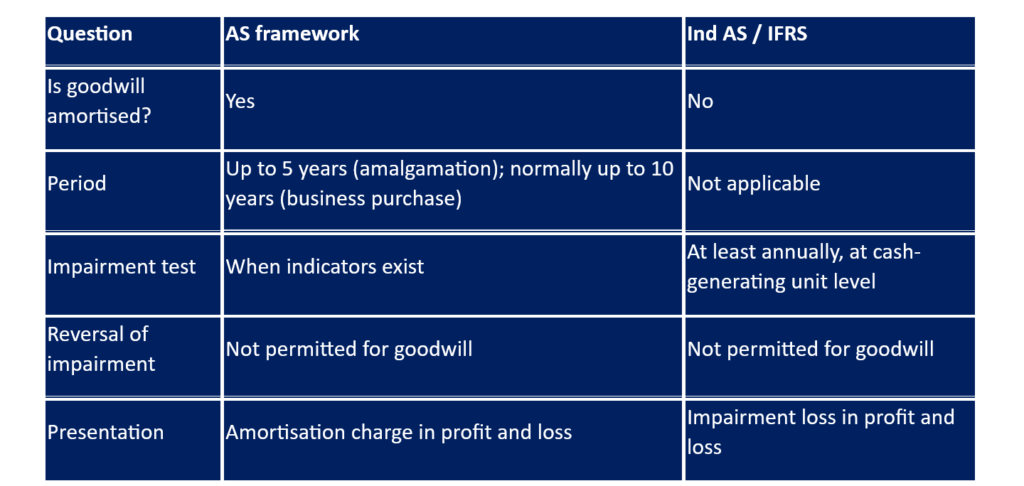
Companies following Accounting Standards (the AS framework) largely sit in the first camp. Companies following Ind AS or IFRS sit firmly in the second.
Under AS 14, goodwill arising on an amalgamation in the nature of purchase is amortised on a straight-line basis over a period not exceeding five years, unless a longer period can be justified. Where goodwill arises instead from the purchase of a business or an undertaking, AS 26 applies: the intangible is amortised over its useful life, with a rebuttable presumption that the life does not exceed ten years from the date the asset is available for use. In both cases the charge goes to the profit and loss account, the method must be reviewed each year, and a shorter life must be adopted if the facts support it.
Under Ind AS 103 and IFRS 3, goodwill is not amortised at all. It is allocated to the cash-generating units expected to benefit from the acquisition and tested for impairment at least annually under Ind AS 36, whether or not any indicator of impairment exists. This is a deliberate policy choice: standard setters concluded that a straight-line write-off over an arbitrary period tells investors less than a rigorous recoverability test. Both the IASB and the FASB revisited the question in recent years and both retained the impairment-only model, though work continues on improving disclosure and the mechanics of the test itself.
The entries
The mechanics are straightforward. On acquisition, the assets and liabilities taken over are recorded at their agreed values, the consideration is credited, and the balancing figure is debited to goodwill. Where the net assets exceed the consideration, the difference is a capital reserve or, under Ind AS, a bargain purchase gain routed through other comprehensive income and accumulated in capital reserve.
In each subsequent year under the amortisation model, the entry is a debit to amortisation expense and a credit to goodwill (or to accumulated amortisation). Under the impairment model, no entry arises unless the test fails, at which point an impairment loss is debited and goodwill is written down. Once goodwill is written down, the reduction is permanent — an impairment loss on goodwill can never be reversed, even if the business recovers.
Where the tax position diverges
This is where many finance teams are caught out. Amortisation of goodwill in the books does not produce a tax deduction. Goodwill of a business or profession has been excluded from the class of depreciable assets since the amendment effective from assessment year 2021-22, and that exclusion continues under the Income Tax Act, 2025, which governs depreciation from the tax year beginning April 2026. Goodwill is simply not part of any block of assets, so no depreciation on goodwill is allowable.
The practical consequences are three. First, the amortisation or impairment charged in the accounts must be added back when computing business income. Second, where depreciation on goodwill was claimed in earlier years under the old position, the cost of acquisition for capital gains purposes is reduced by the depreciation already obtained. Third, a permanent gap opens between the book carrying amount and the tax base of goodwill — and under Ind AS 12, no deferred tax liability is recognised on the initial recognition of goodwill in any event. Teams that mechanically run a deferred tax model over every book-to-tax difference will get this wrong.
What auditors look for
Three issues recur. The first is the allocation of purchase consideration. Goodwill is a residual, so any intangible that should have been identified separately — brands, customer contracts, non-compete arrangements, technology — and was not, inflates goodwill and understates the amortisation charge. A defensible purchase price allocation is the first line of defence.
The second is the useful life assumption. A ten-year life chosen because the standard permits it, rather than because the evidence supports it, will not survive scrutiny. The presumption is rebuttable in both directions.
The third is the impairment test itself. Under the Ind AS model, the allocation of goodwill to cash-generating units, the cash flow projections, the discount rate and the terminal growth assumption all require documentation. Regulators consistently challenge generic sensitivity disclosures and optimistic long-term growth rates. Goodwill impairment testing is not a year-end formality; it is a valuation exercise with an audit trail.
Frequently asked questions
Is goodwill amortised or only tested for impairment? It depends on the framework. Under the AS framework goodwill is amortised. Under Ind AS and IFRS it is not amortised and is tested for impairment at least once a year.
What is the maximum period for amortisation of goodwill? Goodwill arising on an amalgamation in the nature of purchase is normally written off over not more than five years. Goodwill arising on the purchase of a business is amortised over its useful life, with a rebuttable presumption of ten years.
Can amortisation of goodwill be claimed as a tax deduction? No. Goodwill is excluded from the block of assets, so neither depreciation nor amortisation on goodwill is deductible. The book charge is added back in the tax computation.
Is self-generated goodwill recorded in the books? No. Only purchased goodwill, arising from an actual acquisition, can be recognised.
Can an impairment loss on goodwill be reversed later? No. Reversal of an impairment loss on goodwill is prohibited under both frameworks.
How is goodwill on consolidation treated? Goodwill arising on consolidation is computed at the date of investment and, under Ind AS, is carried without amortisation and tested for impairment. Under the AS framework, group policy on amortisation must be applied consistently and disclosed.
What happens to goodwill in a common control transaction? Where an acquisition is between entities under common control, pooling of interests applies under Ind AS and no goodwill arises — the difference is taken to capital reserve.
How SRC Chartered Accountants can help
Goodwill is one of the few balance sheet items where an accounting decision, a valuation judgement and a tax position all have to line up. SRC Chartered Accountants supports clients across the full cycle:
- Purchase price allocation — identifying and valuing separable intangibles so that goodwill is a true residual, not a parking account.
- Useful life and amortisation policy — setting a defensible life, documenting the basis, and building the amortisation schedule.
- Impairment testing — defining cash-generating units, building the recoverable amount model, stress-testing assumptions and preparing the supporting file.
- Tax alignment — computing the add-backs, tracking cost of acquisition for future capital gains, and getting the deferred tax position right.
- Disclosures and audit support — drafting the notes to accounts and standing behind the numbers through the audit.
If your business is acquiring, restructuring or carrying goodwill that has not been reviewed recently, a short diagnostic is usually enough to tell you whether the treatment will hold. Talk to SRC Chartered Accountants to have your goodwill position reviewed before your auditor or assessing officer does it for you.