

An income tax order is not a verdict. It is the opening of a clock. Almost every order that lands in a taxpayer’s inbox carries a window — thirty days, sixty days, four years — inside which a remedy exists and outside which it quietly disappears. The most expensive mistakes in tax administration are rarely about the merits of a claim. They are about a reply filed late, a wrong remedy chosen, or a demand left unattended while interest accumulated in the background.
The task, therefore, is not to fear the order but to read it correctly. Every order answers three questions if you look for them: which authority issued it, under which provision, and what it demands or denies. Get those three right, and the correct response follows almost mechanically.
Start with the year, not the order
Since 1 April 2026, two statutes run side by side. The Income tax Act, 2025 governs tax years beginning on or after that date. Everything relating to an earlier year — pending assessments, appeals, penalties, even rectifications initiated years later — continues under the repealed 1961 Act, protected by the savings provisions of section 536. The test is not when the notice arrived or when the order was passed; it is which tax year the income belongs to.
This matters in practice. A reply drafted in the new numbering on an old-year matter reads as though the adviser did not check. Quote the familiar 1961 sections for legacy years and the 2025 sections for current ones. Where a limitation period had already expired under the old law, the new Act does not revive it.
Reading the common orders
The processing intimation.
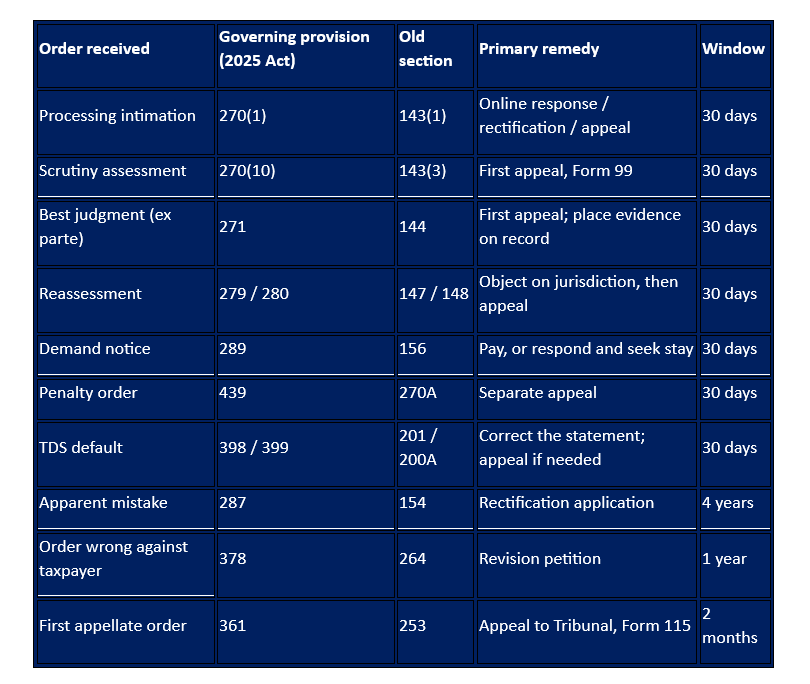
The first communication most taxpayers receive is an intimation on processing of the return — section 270(1) of the 2025 Act, the old section 143(1). It is not a scrutiny order. It reflects arithmetical corrections, obviously incorrect claims, mismatches with the audit report, or losses disallowed because the return was late. The department is required to communicate proposed adjustments and consider the response before finalising, and the response window is thirty days. Ignore that window and the adjustment simply goes through. Where the intimation determines a sum payable, it is deemed to be a notice of demand in its own right.
The scrutiny assessment order.
Where a return is picked up for detailed examination, the assessment order under section 270(10) — old section 143(3) — records additions, disallowances and the resulting tax. Most of these are now passed through the faceless mechanism under section 273, which means the written record is everything. There is no corridor conversation to fall back on; whatever was not uploaded, was not said.
The best judgment order.
Section 271, the old section 144, is the ex parte route. It follows a failure to file a return, a failure to respond to notices, or non-compliance with a direction on audit or inventory valuation. These orders are typically the harshest in quantum and the most vulnerable on appeal, because they are estimates rather than findings. The remedy is to put the missing evidence on record and explain the non-compliance credibly.
The reassessment order.
Where income is believed to have escaped assessment, the reassessment machinery under sections 279 to 286 applies, with the notice issued under section 280 and a preceding procedure under section 281. The first line of defence in reassessment is almost always jurisdictional — whether the notice was validly issued, sanctioned and served within the prescribed time — and that objection must be raised at the outset, not saved for later.
The demand notice.
Section 289, the old section 156, follows any order creating a liability. Payment is due within thirty days. Beyond that, interest runs monthly and the taxpayer can be treated as being in default, with recovery consequences attaching. Filing an appeal does not, by itself, suspend the demand: a separate stay application is needed, and the working convention is that recovery is held in abeyance where a portion of the disputed demand — conventionally twenty percent — has been paid, with full or partial waiver available in appropriate cases.
The penalty order.
Penalty for under-reporting and misreporting of income sits in section 439, the old section 270A. Penalty proceedings are distinct from assessment proceedings, carry their own show cause stage and their own appeal, and are frequently winnable even where the addition itself is not — particularly where the issue is a bona fide difference of view rather than a suppression of fact.
TDS and TCS default orders.
A deductor who fails to deduct or deposit is dealt with under section 398 — the old sections 201(1) and 201(1A) — while processing intimations on TDS and TCS statements arise under section 399. Short-deduction and late-deposit demands are often the result of PAN errors, challan mismatches or return-level data problems, and are corrected far more cheaply by fixing the statement than by litigating the demand.
Rectification and revision orders.
Section 287, the old section 154, allows correction of a mistake apparent from the record — a credit not given, an arithmetical slip, a figure carried wrongly. The authority can act on its own or on application, and generally must dispose of a taxpayer’s application within six months from the end of the month of receipt, with the underlying power exercisable within four years from the end of the financial year in which the original order was passed. Revision runs in two directions: section 378, the old section 264, lets a taxpayer ask the Commissioner to revise an order that is wrong against them, while section 377, the old section 263, is the department’s own power to revise an order it considers erroneous and prejudicial to revenue.
Choosing the right remedy
The instinct to appeal everything is expensive. Where the grievance is a single obvious error on the face of the record, rectification is faster and free. Where it is a narrow, clearly documented point that does not need a full hearing, a revision petition can resolve it without entering the appellate queue. Appeal is the right route where there is a genuine contest on facts or law.
The first appeal lies before the Joint Commissioner (Appeals) or the Commissioner (Appeals) — appealable orders are listed in sections 356 and 357, with form, fee and limitation in section 358, procedure in section 359 and appellate powers in section 360. It is filed electronically in Form 99, which replaces the old Form 35, within thirty days of service of the order or demand notice. Two practical conditions decide whether it is admitted at all: tax on the returned income — the undisputed part — must be paid first, and the grounds must be complete, because they are difficult to expand later. Delay can be condoned where sufficient cause is shown, but condonation is a concession, not an entitlement.
The second appeal lies to the Appellate Tribunal under sections 361 to 364, filed in Form 115 within two months. Beyond that, the High Court hears substantial questions of law under section 365. Two newer mechanisms are worth knowing: a repetitive-appeal declaration allows an appeal on an identical question to be held pending a higher court’s ruling, and a deferment application allows filing to be postponed until that ruling arrives — both useful where the same issue recurs across years.
Quick reference
Frequently asked questions
Does filing an appeal stop recovery of the demand?
No. The demand remains enforceable unless a stay is granted. A separate application must be made, and part-payment of the disputed demand is ordinarily expected while the appeal is pending.
What happens if the thirty-day window is missed?
For a demand, interest begins to run and default consequences follow. For an appeal, the remedy is an application for condonation of delay supported by a genuine, documented reason. Negligence is not sufficient cause.
Can rectification and appeal be pursued at the same time?
They can coexist, but they should not overlap on the same issue. Rectification is for mistakes apparent from the record; an issue requiring argument belongs in appeal.
Is there a way to fix an ex parte order without a full appeal?
Sometimes. Where the non-compliance was for a defensible reason and the underlying position is clean, a rectification or revision route may resolve it. Where quantum is genuinely contested, appeal is the safer path.
Which Act applies to an old year after 1 April 2026?
The repealed 1961 Act. The savings provisions preserve proceedings, rights and liabilities relating to tax years beginning before that date, whether the proceeding was pending or is initiated later.
Do orders passed faceless carry less weight?
No. They carry the same legal effect. What changes is the evidentiary discipline: submissions, annexures and reconciliations must be complete and uploaded, because the record is the only version of events the authority sees.
Is a penalty automatic once an addition is confirmed?
No. Penalty requires its own proceeding and its own finding. A sustainable addition does not always support a sustainable penalty.
How SRC can help
SRC Chartered Accountants works with businesses and individuals across the full arc of a Income tax order — from the first intimation to the appellate hearing. Our approach is deliberately front-loaded: most disputes are decided by the quality of the first reply, not the eloquence of the last one.
We review the order to confirm which statute and which limitation period apply, identify whether the correct remedy is a response, a rectification, a revision or an appeal, and quantify the exposure before any step is taken. We prepare and file responses to processing intimations and demand notices, draft submissions in faceless assessment and reassessment proceedings with a complete documentary record, file first appeals in Form 99 and Tribunal appeals in Form 115, and pursue stay applications where recovery pressure is immediate. We also handle the quieter work that prevents disputes altogether — reconciling tax credits, correcting TDS statements before they become demands, and tightening the documentation that assessments turn on.
If an order has reached you, the clock is already running. A short conversation early is almost always cheaper than a long appeal later.
This article is general in nature and does not constitute professional advice. Provisions, forms and timelines should be verified against the applicable Act, Rules and notifications before any action is taken.